
‘The AI Doc: Or How I Became an Apocaloptimist’ Film Review
by William Lindus
There’s a persistent trap in documentary criticism: the tendency to evaluate a film not on its craft, structure, or effectiveness, but on whether we agree with its conclusions. It’s an understandable impulse - documentaries often deal in urgent, real-world stakes - but it can flatten a more nuanced assessment. A well-made documentary is not necessarily one that tells you what to think; it’s one that clearly understands its intent and executes against it with precision.
That distinction is essential when approaching The AI Doc: Or How I Became an Apocaloptimist, directed by Daniel Roher and Charlie Tyrell, with production involvement from Daniel Kwan (Everything Everywhere All At Once). This is a film I found myself at odds with - particularly in its conclusions and its ultimately centrist framing of artificial intelligence - but one I also recognize as exceptionally well-crafted. In many ways, those two reactions coexist rather than contradict.
From a purely formal standpoint, the documentary is striking. Its central premise is intimate and effective: Roher, on the cusp of becoming a father, sets out to understand whether the world his child will inherit is one defined by promise or peril in the age of AI. This personal throughline anchors what could otherwise be an overwhelming or abstract subject, grounding the film in emotional immediacy.
The structure follows a deliberate progression. Roher first immerses himself in polarized perspectives - futurists who envision AI as humanity’s greatest leap forward, and doomsayers who warn of existential collapse. These interviews are not caricatures; they are presented with clarity and, importantly, with space to breathe. From there, the film pivots toward more measured voices - researchers, ethicists, and practitioners who operate in the gray space between utopia and catastrophe. Finally, it culminates in conversations with high-profile industry leaders, including Sam Altman, alongside figures from organizations like DeepMind and Anthropic.
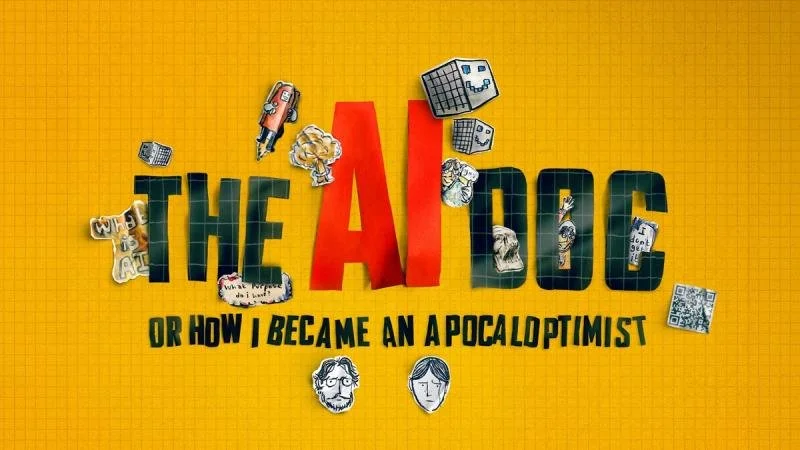
Visually, the film is nothing short of remarkable. Interviews are crisply shot, often intercut with reaction shots of Roher himself - an effective device that allows the audience to process the material alongside him in real time. The documentary’s aesthetic vocabulary is equally ambitious: stop-motion sequences, hand-drawn illustrations, traditional animation, and personal archival footage are woven together into a cohesive whole. This multimodal approach does more than provide visual variety; it reinforces one of the film’s implicit themes - the enduring, adaptive creativity of the human mind in contrast (and sometimes in collaboration) with machine-generated output.
In terms of accessibility, The AI Doc: Or How I Became an Apocaloptimist succeeds admirably. It functions as a strong entry point into a complex and often intimidating subject. Viewers come away with a working understanding of key concepts, a sense of the technological landscape, and an introduction to the major ethical and societal questions surrounding AI. It is, in that sense, an effective primer - arguably one of the best recent attempts to translate the discourse of artificial intelligence into something broadly digestible.
Where the film falters, however, is in the resolution of its own inquiry.
Despite engaging with serious concerns - environmental costs, resource consumption, labor implications, and global inequities - the documentary tends to gesture at these issues rather than fully interrogate them. Topics like land use, emissions, and water strain on vulnerable communities are introduced but not explored with the same depth or urgency afforded to more optimistic narratives. The result is an imbalance that becomes more pronounced as the film moves toward its conclusion.
This culminates in a call to action that feels underdeveloped. The suggestion that viewers should contact their government representatives to advocate for responsible AI governance is not, in itself, unreasonable. But it lands with limited impact because the film has not sufficiently articulated the stakes of inaction. Without a deeper excavation of potential consequences, the appeal lacks the weight necessary to galvanize.
More broadly, the film’s centrist posture - its attempt to reconcile competing extremes into a tempered middle ground - ultimately renders its conclusions somewhat diffuse. There are moments where a more confrontational stance could have sharpened the narrative, particularly in examining the economic and systemic forces driving what the film itself describes as a “race to the bottom.” Instead, the solutions presented feel cautious, even restrained, as though unwilling to fully challenge the structures underpinning the issues it raises.
And yet, none of this negates the film’s value.
The AI Doc: Or How I Became an Apocaloptimist is an engaging, thoughtfully constructed introduction to one of the defining conversations of our time. It educates without overwhelming, entertains without trivializing, and invites curiosity without demanding agreement. Its greatest strength may lie in its ability to open the door - to give viewers the vocabulary and context needed to begin forming their own perspectives.
But it is, crucially, a beginning - not an endpoint.
For audiences new to the subject, this documentary is an excellent first stop. It provides the scaffolding for understanding AI’s promises and pitfalls, delivered through compelling storytelling and polished filmmaking. What it does not provide - and perhaps cannot, given its chosen framing - is a definitive stance on what should come next.
That responsibility, the film suggests - perhaps unintentionally - belongs to the viewer.

3.5 out of 5 Bear Paws